New publication from Wildermuth et al. in Nature Ecology and Evolution: Arthropod species loss underpins biomass declines
A new study shows that over 90% of insect biomass declines are driven by shrinking species numbers, posing a risk to ecosystem function.
Recent declines in arthropod diversity, abundance and biomass are central to the global biodiversity crisis. Yet, we lack a mechanistic understanding of the respective contributions of species richness, species identity and abundance to overall biomass change, and how the environment filters these processes. Synthesizing 11 years of data from a biodiversity experiment and from farmed grasslands in central Europe across a gradient of plant species richness and land-use intensity, we show that local arthropod biomass declines were predominantly (>90%) linked to species richness losses. Abundance declines among persisting species accounted for only 5–8% of lost biomass. The role of species identity depended on the environment and diminished over time: especially under high plant diversity and low land-use intensity, arthropod species with both below-average total biomass and above-average individual biomass (large, rare species) contributed disproportionately to species turnover—but this was only detectable in early years when the communities were still relatively abundant. We conclude that arthropod communities are currently homogenizing towards few common species of similar biomass, probably reducing their adaptability to future environmental change. Increasing the diversity and reducing the land-use intensity of grasslands may mitigate ongoing community simplification and loss of arthropod diversity and functioning.
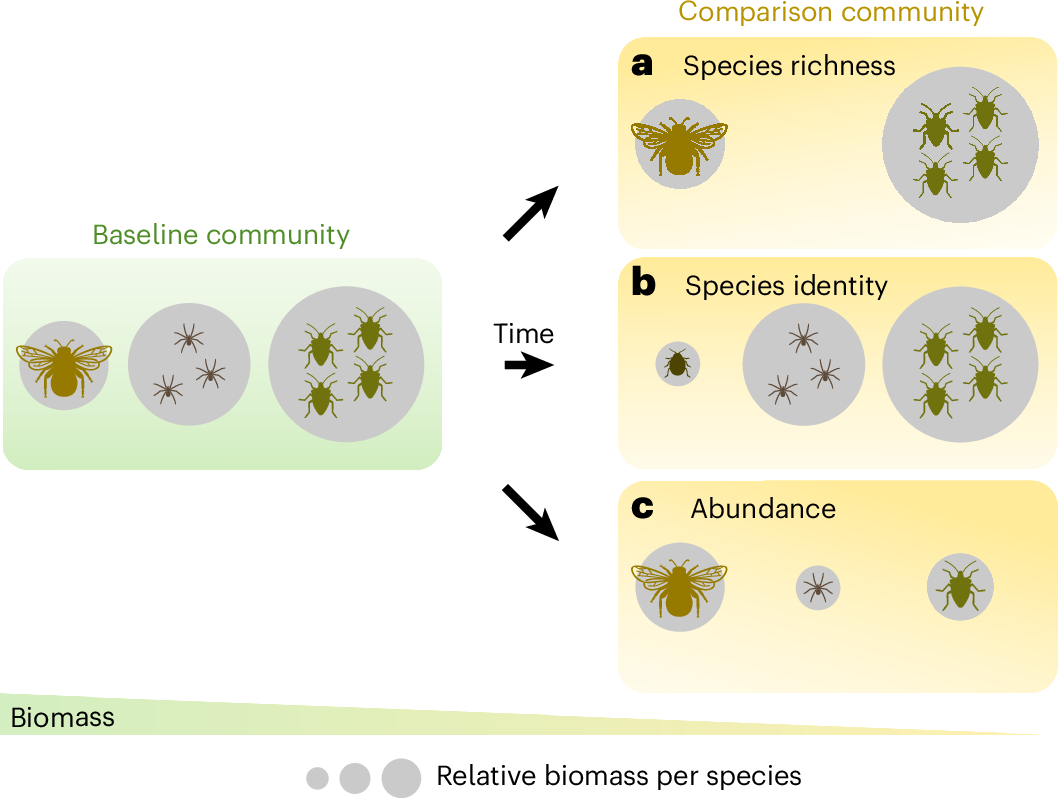
a–c, Changes in the total community biomass can be associated with changes in species richness (a), species identity (b) and abundance of persisting species (c). The species richness component assumes an equal (average) contribution of all species to community biomass. However, species under turnover may have non-average biomass (b), in which case their identity must be considered. Consequently, the species identity component reflects the difference between the biomass change expected from the species richness component and the actual observed biomass change associated with species turnover. In comparison community a, one species with average total biomass relative to the baseline community was lost (the expected species richness change explains the observed biomass change); in comparison community b, one species with below-average total biomass was lost and one species with even lower biomass was gained (species identity change has to be considered to explain the observed biomass change); and in community c, no species was lost or gained, but the abundances of two species declined (abundance changes of persisting species explain the biomass change). All scenarios can occur in combination (see Extended Data Fig. 1 for an illustrated example). Reversing the roles of baseline and comparison in this hypothetical scenario would illustrate opposite trends of community and biomass changes. Credit: arthropod icons, Gabriele Rada/iDiv.
Reference:
Wildermuth, B., M. Bröcher, E. Ladouceur, S. T. Meyer, H. Schielzeth, M. Staab, R. Achury, N. Blüthgen, L. Hertzog, J. Hines, C. Roscher, O. Schweiger, W. W. Weisser, and A. Ebeling. 2025. Arthropod species loss underpins biomass declines. Nature Ecology & Evolution:1–12. https://doi.org/10.1038/s41559-025-02909-y